
100 Years Since the General Strike: The Miner’s Lamp, Industrial Heritage and Wolf Safety
As the centenary of the 1926 General Strike is marked, the familiar image of the miner’s safety lamp offers a moment to reflect on mining heritage, industrial safety and Wolf Safety’s own history.
%20(1).png)
Wolf Patterson Approved Flame Safety Lamp leaflet, 1927 — produced shortly after the 1926 General Strike and reflecting Wolf’s long association with mining safety
Across parts of the UK, posters and events are marking 100 years since the 1926 General Strike — one of the most significant moments in Britain’s industrial and labour history.
The General Strike was rooted in the coal industry, arising from disputes over miners’ pay, working hours and conditions. For nine days, workers across transport, heavy industry and other sectors took strike action in support of the miners. The miners’ dispute itself continued much longer, leaving a lasting mark on mining communities and on the wider history of British industry.
At Wolf Safety, we are not historians of the General Strike, nor is it our place to use that history as a promotional opportunity. The events of 1926 belong first and foremost to the people, families and communities directly affected by them.
But one image appearing in centenary posters and commemorations has a particular resonance for us: the miner’s safety lamp.
The General Strike was rooted in the coal industry, arising from disputes over miners’ pay, working hours and conditions. For nine days, workers across transport, heavy industry and other sectors took strike action in support of the miners. The miners’ dispute itself continued much longer, leaving a lasting mark on mining communities and on the wider history of British industry.
At Wolf Safety, we are not historians of the General Strike, nor is it our place to use that history as a promotional opportunity. The events of 1926 belong first and foremost to the people, families and communities directly affected by them.
But one image appearing in centenary posters and commemorations has a particular resonance for us: the miner’s safety lamp.
A symbol of danger and protection
Few objects are more closely associated with mining than the safety lamp. It is a symbol of the industry itself: practical, familiar and instantly recognisable. It also represents something much deeper — the constant need to manage risk in some of the most challenging working environments.
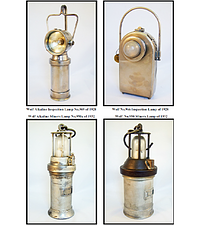
Wolf alkaline inspection and miners’ lamps from 1928 and 1932, showing the continued development of safe lighting for underground work.
Before the development of flame safety lamps, miners often worked with open flames (candles or oil lamps), adding further danger in environments where methane, historically known as firedamp, could be present. The development of the safety lamp did not remove the dangers of mining, but it helped address one of its most serious hazards: the risk of ignition in explosive atmospheres.
The lamp therefore became more than a source of light. It became part of a wider culture of industrial safety, where equipment, knowledge, discipline and design all played a role in protecting workers underground.
Wolf Safety and mining heritage
Wolf Safety’s roots sit within a long tradition of mining safety-lamp development. The story begins with the German manufacturer Friemann & Wolf (Zwickau), whose lamps were being imported into Britain by the late 19th century. In the early 1900s a Leeds-based “Wolf Safety Lamp Company” operation developed, but by 1912 had closed. That same year Friemann & Wolf approached mining engineer William Maurice to re-establish a strong British base. Maurice’s work with Wolf began in 1912, and the business was later incorporated under his ownership in 1916 — foundations for the Sheffield company that endures today.
%20(1).png)
The Wolf Federation Alkaline Gas Detector Lamp of 1928 — an example of the close relationship between mining lamps, gas detection and worker safety.
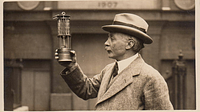
William Maurice, founder of the Sheffield Wolf Safety Lamp Company, pictured with a safety lamp.
That South Yorkshire connection matters. By the 1910s, the Wolf business had become firmly rooted in the same regional industrial landscape that shaped mining communities across Yorkshire, Derbyshire, Nottinghamshire and beyond.
For many years, mining safety lamps were central to the company’s work. Over time, as mining changed and demand for mine lighting declined, Wolf diversified into other industrial sectors. The company’s focus, however, remained consistent: designing and manufacturing lighting and equipment for use where safety is critical.
From the mine to modern Hazardous Area industries
Today, Wolf Safety designs and manufactures ATEX and IECEx certified lighting and power distribution equipment for safe use in potentially explosive atmospheres worldwide.
The industries have changed. The technology has changed. The light sources, materials, standards and certifications have evolved enormously.
But the underlying principle remains familiar: in environments where flammable gases, vapours, mists or dusts may be present, lighting and electrical equipment must be designed with safety at its core.
Modern Hazardous Area lighting is a long way from the flame safety lamps of the mining industry. Yet there is a clear line of continuity between those early lamps and the products used today in oil and gas, chemical, marine, aviation, power generation, utilities and other demanding industrial sectors.
Both are built around the same fundamental requirement: helping people work safely in places where ordinary equipment may create unacceptable risk.
Remembering the people behind the symbol
The centenary of the General Strike is a moment of reflection for many reasons. For some, it is about labour history. For others, it is about mining communities, family memory, social change, or the relationship between workers, employers and government.
For Wolf Safety, the connection is narrower but meaningful.
The miner’s lamp reminds us of the people who worked underground, the conditions they faced, and the importance of equipment designed specifically for hazardous environments. It also reminds us that industrial safety is never just a technical subject. It is about people — their work, their wellbeing and their return home at the end of a shift.
As the safety lamp appears again in public view during this centenary year, it is worth pausing to recognise its significance. Not simply as a historic object, but as an enduring symbol of industrial risk, practical innovation and the continuing importance of safety in hazardous workplaces.
Wolf’s products have changed greatly since the days of mining lamps, but the purpose behind them remains recognisably the same: to provide safe, reliable lighting and equipment for people working in hazardous environments.
To learn more about Wolf Safety’s history, visit our History page or explore our range of certified lighting and power distribution solutions for Hazardous Areas