
The Miner’s Lamp: A Symbol of Safety, Light and Wolf Safety's Heritage
A small lamp, carried deep underground, became one of the most powerful symbols of industrial safety. At a time when flammable gases could turn a simple flame into a lethal hazard, the miner’s safety lamp represented something vital: the ability to bring light into dangerous environments without increasing risk. A century on — as the centenary of the 1926 General Strike is marked across the UK — that same symbol continues to resonate.
%20(1).png)
Wolf Patterson Approved Flame Safety Lamp leaflet, 1927 — Wolf has a long association with mining safety and safe lighting for underground work.
For many, the miner’s lamp represents the mining industry, the working lives of miners, and the communities built around coal. But it also carries a deeper meaning — one that sits at the heart of Wolf Safety’s history.
It represents safety, protection and the responsibility to design equipment that helps people work safely in hazardous environments.
A heritage built around safer working
Wolf Safety’s story is closely connected with the mining industry and the development of safety lamps for use in hazardous environments.
The company’s roots go back to the late nineteenth and early twentieth centuries, when Wolf safety lamps were being developed, and manufactured for the mining industry. In 1912, William Maurice became manager of The Wolf Safety Lamp Company Ltd, bringing with him significant experience in mining, engineering and electrical safety.
Maurice was not simply a businessman involved in lamps. He had worked directly in mining environments, with experience as a colliery electrical engineer and manager, and a strong belief in the role of better lighting and electrical engineering in improving mine efficiency and the safety of workers.
That combination of practical experience, technical understanding and commitment to safer working helped shape the direction of Wolf Safety for decades to come.
By the 1920s and 1930s, Wolf was producing and developing a range of flame safety lamps, alkaline lamps and other mining-related lighting products — practical tools designed for demanding industrial conditions.
Archive images from this period show a company deeply connected to the mining industry and to the ongoing development of safer lighting for people working underground.
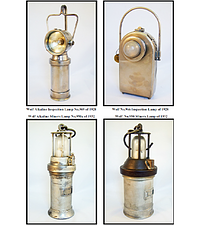
Wolf alkaline inspection and miners’ lamps from the late 1920s and early 1930s, showing the continued development of safe lighting for mining environments.
More than a source of light
The miner’s flame safety lamp is often remembered visually — the metal bonnet, glass cylinder, protective gauze and distinctive handle. Its form is so familiar that it remains a lasting symbol of mining heritage.
Its true significance, however, lies in what it was designed to achieve.
A miner’s lamp needed to deliver reliable light in an environment where ordinary lighting could be dangerous, while remaining robust enough for constant industrial use. Above all, it had to be engineered with a detailed understanding of the risks surrounding it — helping miners work effectively while reducing the chance of ignition in explosive atmospheres.
Those same principles remain just as relevant today.
%20(1).png)
The Alkaline Gas Detector Lamp (1928) demonstrates the relationship between miners’ lamps, gas detection and workplace safety.
Modern Hazardous Area industries are very different from the coal mines of the early twentieth century. Today, Wolf Safety designs and manufactures ATEX and IECEx certified portable, temporary, area and installed lighting equipment for safe use in potentially explosive atmospheres around the world.
The products have changed enormously. Flame safety lamps have given way to advanced certified electrical equipment. Materials, light sources, testing methods and international standards have all evolved.
But the purpose remains recognisable.
Wolf Safety exists to help people work safely in hazardous environments.
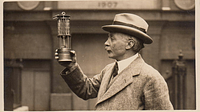
William Maurice, an important figure in Wolf Safety’s history, pictured with a safety lamp.
From mining lamps to modern Hazardous Area safety
The industries Wolf serves today include oil and gas, chemical, marine, aviation, power generation, utilities and other sectors where safety-critical equipment is essential.
In these environments, lighting and electrical equipment must meet strict requirements. Risks may involve flammable gases, vapours, mists or combustible
dusts, but the underlying challenge remains the same: equipment must be safe and suitable for the environment in which it is used.
This is where Wolf’s heritage continues to matter.
The company’s early mining lamps were developed for conditions where the wrong light source could create unacceptable danger. Today’s products follow the same safety-led philosophy, applying modern design, engineering and certification to support safe working in Hazardous Areas worldwide.
The miner’s lamp is therefore more than a historic object. It is part of a longer story about industrial safety, practical engineering and the ongoing responsibility to protect people at work.
A symbol that still matters
A hundred years after 1926, the miner’s lamp remains one of the most recognisable symbols of British industrial history - associated with mining communities, resilience and the realities of working underground.
For Wolf Safety, it represents something precise and enduring: the importance of safe, reliable light in hazardous environments.
That idea has shaped the company for more than a century. From early miners’ lamps to today’s certified Hazardous Area lighting and power distribution solutions, the focus has remained consistent - helping people work safely where ordinary equipment is not safe or suitable.
The technology has changed. The industries have changed. The standards have changed.
But the commitment behind the products remains the same: safety, reliability and light for people working in hazardous environments.
CONTINUING A CENTURY OF SAFER WORKING
From early miners’ lamps to today’s certified lighting, power distribution and ventilation equipment, Wolf Safety has been focused on one principle for more than a century: helping people work safely in hazardous environments.
Explore our Hazardous Area solutions or learn more about Wolf Safety’s heritage to see how that expertise supports safer working across industries worldwide.